DoDAF viewpoints and models
Why viewpoints and models?
The Department of Defense Architecture Framework (DoDAF) has been designed to meet the specific business and operational needs of the Department of Defense.
The DoDAF defines a way of representing an enterprise architecture that enables stakeholders to focus on specific areas of interests in the enterprise while retaining sight of the big picture.
To help decision-makers, DoDAF provides ways to abstract essential information from underlying complexity and present this information in ways that maintain coherence and consistency.
A principal objective of DoDAF is to present this information in ways that can be understood by many stakeholders who develop, deliver, and sustain capabilities that support missions of the DoD.
The DoDAF does this by dividing a problem space into manageable pieces that correspond to stakeholder viewpoints, which are further defined as models.
Each viewpoint has its own purpose. Each viewpoint usually presents information in one or more of these categories:
- information that broadly summarizes the whole enterprise (e.g., high-level operational concepts)
- information that focuses narrowly on a special concern (e.g., low-level implementation details)
- information that shows how elements of an enterprise are connected (e.g., how an activity is supported by some system).
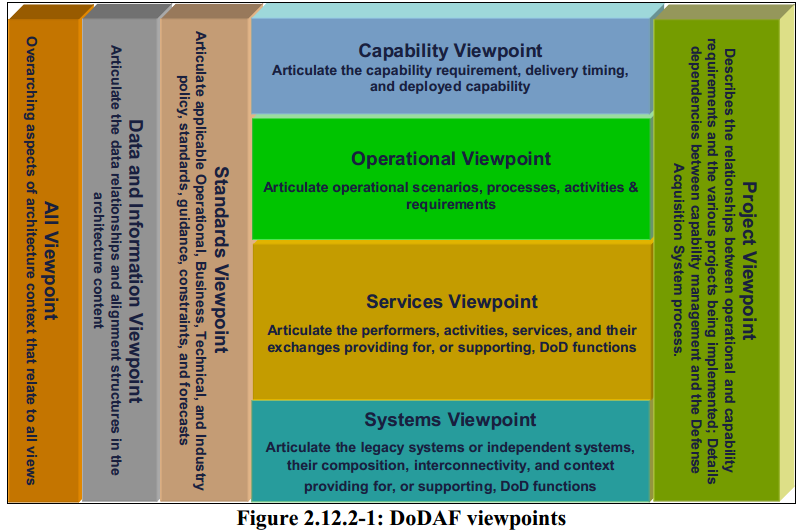
DoDAF organizes models into these viewpoints:
- The All Viewpoint describes overarching aspects of an architecture context that relate to all viewpoints appropriate for the architecture.
- The Capability Viewpoint describes capability requirements, delivery timing, and deployed capabilities.
- The Data and Information Viewpoint describes data relationships and alignment structures in the architecture content for the capability and operational requirements, systems engineering processes, and systems and services.
- The Operational Viewpoint describes operational scenarios, activities, and requirements that support capabilities.
- The Project Viewpoint describes relationships between operational and capability requirements and various projects to deliver capabilities. The Project Viewpoint also details dependencies among capability and operational requirements, systems engineering processes, systems design, and services design within the Defense Acquisition System process.
- The Service Viewpoint describes the performers, activities, services, and resources that provide or support operational, capability, and system functions.
- The Standards Viewpoint describes applicable policies, standards, guidance, constraints, and forecasts that shape capability and operational requirements, systems engineering processes, systems, and services.
- The System Viewpoint describes systems, their composition, connections, and contexts that provide or support operational and capability functions.